Unlocking the Secrets of Taekwondo Kicks
In the dynamic world of Taekwondo, mastering kicks is essential for developing both power and control. At DojoRift, a modern martial arts platform dedicated to the mastery and evolution of Karate, Taekwondo, and Kyokushin, we believe that understanding the mechanics behind effective kicks can elevate your training to new heights. Whether you’re a beginner eager to learn foundational techniques or a seasoned martial artist refining your skills, precise footwork and proper technique are the cornerstones of generating explosive power and pinpoint accuracy.
The Role of Precise Footwork in Taekwondo
Why Footwork Matters
Footwork is often underestimated in martial arts, yet it is the foundation upon which all kicks are built. Proper foot positioning and movement enable:
- Improved stability: Maintaining balance during executed kicks.
- Enhanced power transfer: Transmitting force efficiently from the ground through the leg and into the target.
- Greater control: Adjusting angles and distances swiftly for effective strikes.
- Faster reaction times: Achieving superior agility and responsiveness in sparring or kata.
Key Footwork Techniques for Effective Kicks
| Technique | Description | Benefits |
| Chamber Step | Properly positioning the supporting foot and chambering the kicking leg before striking. | Ensures balance and optimal alignment for maximum power. |
| Pivoting | Rotating on the supporting foot to change angles and maximize reach. | Adds torque and extension to kicks like roundhouses and sidekicks. |
| Step-and-Kick | Moving quickly into range before executing the targeted kick. | Improves timing and control for dynamic combat situations. |
| Lateral Movement | Shifting sideways to avoid attacks and position for attacks. | Keeps your stance flexible and unpredictable. |
Mechanics of Power in Taekwondo Kicks
The Principles Behind Explosive Kicks
Effective Taekwondo kicks rely on a combination of precise mechanics:
- Proper hip rotation: Power originates from the hips, not just the leg.
- Core engagement: Stabilizes the torso and transmits force efficiently.
- Speed of movement: Faster execution increases impact force due to momentum.
- Follow-through: Ensuring the kicking foot fully extends through the target maximizes energy transfer.
Important Kicks for Power and Control
- Roundhouse Kick (Dollyo Chagi): Utilizes hip rotation and snap to generate significant power while maintaining control.
- Front Kick (Ap Chagi): Focuses on direct, linear force with proper knee chamber and snap.
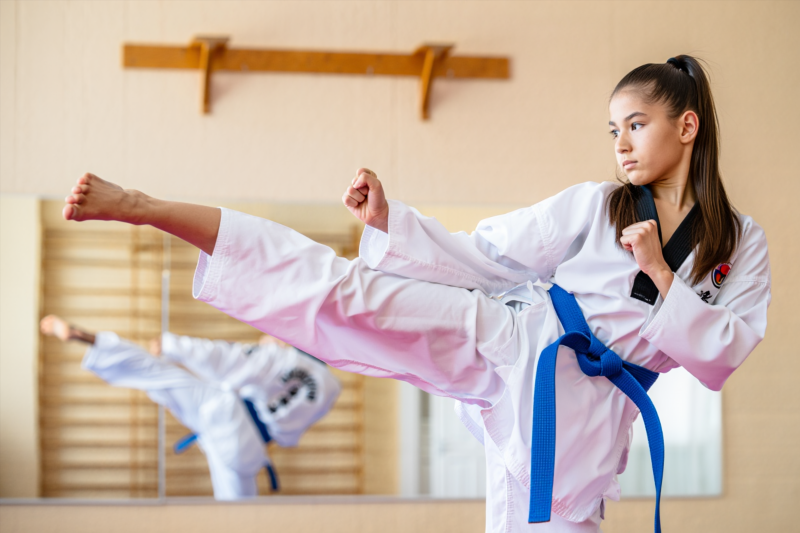
- Side Kick (Yop Chagi): Emphasizes pivot and lateral hip rotation, offering both power and precision.
- Back Kick (Dwid Balki Chagi): Requires accurate targeting and balance, delivering overwhelming force backward.
Expert Tips for Better Control and Power
- Focus on Proper Stance Foundation
Maintaining a stable, balanced stance like a horse stance or fighting stance ensures your kicks are rooted in stability, allowing for controlled power.
- Refine Your Chamber Technique
The chamber position (lifting the knee high before striking) prepares your muscles for maximum acceleration and prevents premature movement, leading to more accurate kicks.
- Practice Slow and Controlled Movements
Slow drills help embed correct mechanics, which can be gradually increased in speed for explosive power without sacrificing control.
- Use Visualizations and Shadow Sparring
Mentally rehearsing the proper mechanics enhances muscle memory, resulting in sharper execution during real matches.
- Integrate Strength Conditioning
Targeted exercises like plyometrics, core workouts, and hip flexibility routines augment your kicking power and stability.
Frequently Asked Questions (FAQs)
How can I improve the accuracy of my kicks?
Focus on precision drills, such as targeting stationary objects or using focus pads. Consistently practicing proper foot positioning and aiming ensures your kicks land exactly where intended.
What’s the best way to generate more power without losing control?
Prioritize hip rotation, core engagement, and snap action. Combining these with proper stance and controlled speed helps produce powerful yet controlled kicks.
How important is flexibility in executing effective kicks?
Flexibility enhances the range of motion, allowing for higher and more impactful kicks. Incorporate regular stretching and dynamic warm-up routines to improve flexibility over time.
Mastering the mechanics of power and control in Taekwondo kicks involves a careful balance of precise footwork, correct technique, and dedicated training. At DojoRift, we’re committed to guiding martial artists through structured drills, expert insights, and practical tools to unlock their full potential. Whether refining a roundhouse or executing a lightning-fast front kick, understanding and applying these principles will elevate your martial arts skills and bring you closer to mastering the art of the warrior.
Ready to enhance your Taekwondo kicks? Start integrating these expert tips today and experience rapid progress in your power and precision!